skip to main |
skip to sidebar
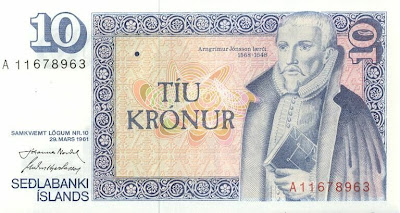 The country has the 5th highest GDP per head; the highest quality of life (shared first place with Norway); is on the second place in the technological readiness index; has the second highest car ownership (632 out of 1000 citizen own a car), and has the 9th highest life expectancy (in fact, it has the second highest male life expectancy, after Andorra).Which country am I writing about? I’ll give you another hint. The country I’m thinking off is the probably worst affected by the credit crunch.Yes, indeed, I am talking about Iceland. Did anyone by any chance check the value of the Icelandic Krona today? – 1 Euro is today worth 145 Krona. That means 1 Krona is not even worth a freaking Euro cent! I remember last year the Euro being worth less that 100 Krona.In Iceland we see for the first time properly, how the financial crisis can affect the state. Prime minister Geir H. Haarde even spoke about the real danger of “national bankruptcy”.The Allthing, the Icelandic parliament, even introduced emergency laws trying to fight the financial crisis. These emergency laws allow the state to interfere with the finance sector. However extreme and brutal these laws are, none of the political parties in the Allthing rejected them. This is how extreme this crisis is.How did it get all that bad? Iceland's banks made a fatal mistake several years ago, offering great deals to people on the ireland and abroad (Britain mostly, but also Germany and the Scandinavian countries). Today, the banks cannot cope with the debts anymore, as they equal to 12 times the size of the entire Icelandic economy.The government now manages the third largest bank, Glitnir Bank, and the second largest bank, Landesbanki Island HF. However, several experts seem to doubt the government's ability to cope with the disastrous banks. One of the emergency laws that were passed by the parliament ruled that the government does not have to guarantee the money in the banks anymore. Nevertheless, the government wants to save the money for Icelandic citizens, but not for foreign investors. This could hit many Britons hard. However, I have heard from informed sources that the British Government might sue Iceland over British deposits account holders with Landsbanki's Icesave Internet banking.The danger that Iceland might become the first country that has to declare national bankruptcy due to the financial crisis is as real as the crisis itself.
Schreiber
 The LHC (Large Hadron Collider) has been put off line for at least two months following a 'quench'. Helium liquid had leaked out meaning that the large electro-magnets were not being cooled, subsequently they heated up to nearly 100 degrees. Fortunately none of the magnets were irreversibly damaged, however due the the nature of the environment even relatively minor repairs are extremely time consuming. The collider tube has be to brought up to ambient temperature from it's maintained near absolute zero to allow workers in.However this is the latest blow to the initially spectacularly successful project. On the start-up day protons completed a full circuit of the 27km is much less than predicted time. Shortly after a 30-ton transformer broke and had to be replaced, no mean feat for something buried under mountains of EU farming subsidies.Here at the innit24 newsroom we wish them all the best for the future (if there is one) and would like to extend our thanks for most-kindly delaying the end of the world so we can all watch the new season of House.
 “The tragedy for Britain has been that politicians of both parties have consistently failed to appreciate the emerging reality of European integration,” Tony Blair said some time long ago. And he was right.
However, I do not want to write about European integration in general, but about the Euro, the currency that unites our Union.Let us firstly ask ourselves: Why do we need the Pound Sterling? We need it, because (at the moment) the Pound is falling (compared to the Euro), which is great for UK exports. (But then, Britain does not export too much anyway).
This, however, also means that if you travel to Euroland, your Frappuccino will cost more, which will make your fun holidays in the wonderful South of France less great.Joining the Euro does not mean that export will be impossible, only fairer. (And, we cannot just hope that the Pound keeps devaluating itself!) Let us have a look at the Thatcherite argument that the Pound is a part of national sovereignty. That’s just rubbish! The Pound is great, I love paying with it, but I have also paid with the Swiss Frank, with the Israeli New Sheqel, with the Turkish Lira, the US Dollar, etc, and I never had a problem with it. The “sovereignty” a national currency represents exists only in the heads of the burghers.
I remember how politicians in all countries in our fine Union had massive problems, as they tried to introduce the Euro and therewith EMU; Germans, for example, certainly did not like to give up their Deutschmark, as it seemed to them to be the only German thing (apart from maybe cars) that actually turned out to be a success (ignoring Heidi Klum). But they survived it, as will this wonderful Kingdom. Even the Danes, who are known for being as reserved (to say the least!) about the EU will have a referendum soon on joining the Eurozone, and it looks as though the Yes-campaigners will win.So far Britain always joint EU-European projects a few years too late in order to truly profit from them. As Britain joint the EEC, the money of the regional trust (to just name one of several) went to Greece, Spain and Portugal, whereas Britain could have profited from it, had it joint a bit earlier. As Britain joint EEC, policies such as the Common Agricultural Policy were already formed and Britain was unable to make them any more Britain-friendly (I will at this point not go into the entire debate on the BBQ). As Britain joint the Exchange Rate Mechanism (or in fact even the EMS), it was too late to be advantages for Britain. This list seems never ending, but Mr Franklin will complain if this post is too long, therefore I shall stop here.
However, it is not quite too late to join the Euro! Yes, by committing earlier to the Euro, Britain could have had more influence on how to set up the European Central Bank (which became some sort of bigger version of the Bundesbank), but the Euro is still evolving (and on the best way to becoming the world’s most important currency) and Britain can participate in this progress.
We need to end this annoying (and politically as well as economically dangerous) eurosclerosis and finally commit to the Euro, one of the greatest achievements of EU-European politics ever!
Schreiber

 The country has the 5th highest GDP per head; the highest quality of life (shared first place with Norway); is on the second place in the technological readiness index; has the second highest car ownership (632 out of 1000 citizen own a car), and has the 9th highest life expectancy (in fact, it has the second highest male life expectancy, after Andorra).


 Posts
Posts


