skip to main |
skip to sidebar
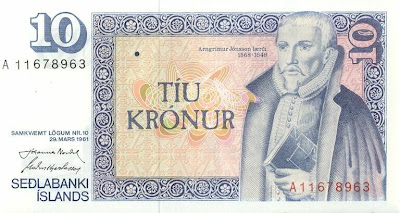 The country has the 5th highest GDP per head; the highest quality of life (shared first place with Norway); is on the second place in the technological readiness index; has the second highest car ownership (632 out of 1000 citizen own a car), and has the 9th highest life expectancy (in fact, it has the second highest male life expectancy, after Andorra).Which country am I writing about? I’ll give you another hint. The country I’m thinking off is the probably worst affected by the credit crunch.Yes, indeed, I am talking about Iceland. Did anyone by any chance check the value of the Icelandic Krona today? – 1 Euro is today worth 145 Krona. That means 1 Krona is not even worth a freaking Euro cent! I remember last year the Euro being worth less that 100 Krona.In Iceland we see for the first time properly, how the financial crisis can affect the state. Prime minister Geir H. Haarde even spoke about the real danger of “national bankruptcy”.The Allthing, the Icelandic parliament, even introduced emergency laws trying to fight the financial crisis. These emergency laws allow the state to interfere with the finance sector. However extreme and brutal these laws are, none of the political parties in the Allthing rejected them. This is how extreme this crisis is.How did it get all that bad? Iceland's banks made a fatal mistake several years ago, offering great deals to people on the ireland and abroad (Britain mostly, but also Germany and the Scandinavian countries). Today, the banks cannot cope with the debts anymore, as they equal to 12 times the size of the entire Icelandic economy.The government now manages the third largest bank, Glitnir Bank, and the second largest bank, Landesbanki Island HF. However, several experts seem to doubt the government's ability to cope with the disastrous banks. One of the emergency laws that were passed by the parliament ruled that the government does not have to guarantee the money in the banks anymore. Nevertheless, the government wants to save the money for Icelandic citizens, but not for foreign investors. This could hit many Britons hard. However, I have heard from informed sources that the British Government might sue Iceland over British deposits account holders with Landsbanki's Icesave Internet banking.The danger that Iceland might become the first country that has to declare national bankruptcy due to the financial crisis is as real as the crisis itself.
Schreiber
 Italians live at home and Portuguese are super-multilingual. One of the most interesting international studies ever, reveals how life is like on Campus Europa. Eurostudent, as the study is called, analysed several different aspects of studying in Europe. The study shows, for example, that it is much easier for students with a non-academic background to get into university in the Netherlands, whereas there are close to no students with a non-academic background to be found in Bulgarian or German universities.
The report, which is due to be published tomorrow, and will certainly lead to some debate in the education supplements in national papers across EU countries and beyond. Innit24 can already present some of the most interesting facts the study will reveal.
Students without a normal university-entrance diploma (such as the British A-Levels, the American High School Diploma, the Swiss Matura, and so on) find it much easier to get into university in England and Wales, whereas it is nearly impossible to do so in Lithuania and Germany, says Eurostudent.
Many students these days study a year abroad, but which county’s students do so the most? Here we see Norway, Germany and Finland scoring the best, Italy, Lithuania and Turkey can be found at the bottom of the list.
One very interesting fact that the study will reveal tomorrow, concerns the ability of students to speak two languages fluently. Here we see Portugal’s students to score best, followed by Slovenian and Swiss students. Again, it is the Turkish, which score worst of all participating countries.
For those of our reader who are still looking for a partner, the following fact might be rather interesting: Italy has the most single students, followed by Portugal and Scotland.In contrast, the country with the most students already married is Norway, followed by Slovakia and Sweden.  Most Italians live with Mum and Dad (73%) (Could that be the reason why they are all single??). This love of living at home seems to be a Mediterranean thing though, as Spanish (64%) and Portuguese (55%) students do the same. On the other hand, students from more northern European countries can’t wait to get away from home. 79% of the Norwegian students live in rented/private flats/houses without their parents, as do 68% of the Finnish students and 65% of those studying in Germany and Austria. (This excludes students living in university halls.)
As I mentioned earlier, the full study will be published tomorrow. You may also want to check out Eurostudnet’s website for more details.
Schreiber

 The country has the 5th highest GDP per head; the highest quality of life (shared first place with Norway); is on the second place in the technological readiness index; has the second highest car ownership (632 out of 1000 citizen own a car), and has the 9th highest life expectancy (in fact, it has the second highest male life expectancy, after Andorra).


 Posts


